
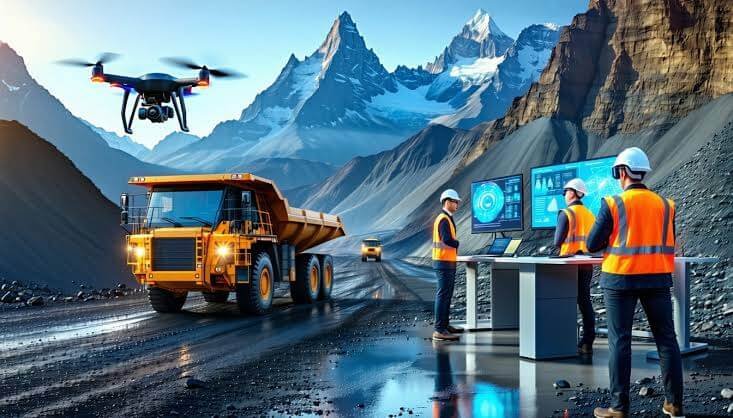

Artificial intelligence integrates diverse sensor data to deliver real-time risk insights and predictive maintenance for remote mining. It enables continuous monitoring, anomaly detection, and autonomous asset guidance while supporting optimized scheduling and logistics. Data governance and transparent models maintain trust, with dashboards and interoperability standards aiding field crews. Climate resilience and cybersecurity are embedded, creating scalable control. The approach raises practical questions about deployment, governance, and measurable gains, inviting ongoing assessment as operations extend into harsher terrains.
How AI Enhances Safety and Predictive Maintenance
AI-driven monitoring enhances safety and predictive maintenance by translating disparate sensor streams into real-time risk insights. The approach aggregates vibration, temperature, and gas readings to forecast equipment failure and structural concerns, enabling proactive interventions.
Data privacy remains central, with access controls and anonymization. Model interpretability supports field crews by revealing decision rationales, fostering trust, experimentation, and adaptable risk management.
Real-Time Monitoring and Autonomous Operations in Remote Mines
Data-driven systems integrate sensor fusion from diverse sources, enabling rapid anomaly detection and adaptive control.
Remote logistics align with autonomous assets, reducing downtime and enabling disciplined workflows while operators monitor complex, scalable sites with clarity and freedom.
Data-Driven Planning: Optimization, Scheduling, and Logistics
Data-driven planning integrates optimization, scheduling, and logistics to align mining workflows with dynamic field conditions. This approach uses data collection to model constraints, capacity, and risks, enabling rapid adjustments as operations evolve. Models are iteratively refined through model tuning, preserving transparency for operators. The result is lean, adaptable sequencing that reduces waste, improves reliability, and sustains autonomous, freedom-forward field performance.
Challenges, Implementation Paths, and a Roadmap for Adoption
How can mining operations balance potential gains from AI-enabled remote work with practical hurdles and deployment realities? The roadmap emphasizes risk assessment, data governance, and leadership engagement, plus ethics and accountability. It integrates workforce transformation, cyber security, change management, cost benefit analysis, and stakeholder communication within regulatory compliance. Vendor selection, interoperability standards, data quality, and incident response planning drive scalability, openness, training, dashboards, and climate resilience.
See also: How Artificial Intelligence Supports Market Research
Frequently Asked Questions
What Are the Cost Implications of AI for Small Remote Mines?
The cost implications for small mines depend on upfront tech, integration, and ongoing maintenance; however, scalable AI reduces downtime and energy waste, delivering faster ROI. Operational flexibility and data-driven decisions empower field teams while preserving independence and adaptability.
How Is AI Governance Ensured in Hazardous Environments?
AI governance is maintained through rigorous safety protocols in hazardous environments, underpinned by AI ethics and ongoing risk assessments; governance audits, traceable decision logs, and field data ensure adaptable, data-driven practices that respect freedom and operational resilience.
Can AI Operate in Extreme Weather or Terrain Offline?
AI can operate offline in extreme weather and terrain, though with reduced scope; AI offline operations confront latency, data gaps, and power limits, yet field-savvy systems adapt. Extreme weather challenges persist, but robust design enables controlled autonomy and resilience.
What Is the ROI Timeline for AI Deployments Offshore or Remote Sites?
ROI timelines for AI deployments offshore or remote sites vary, typically 12–36 months with scalable gains. AI governance and data ownership frameworks influence speed and value; adaptability and field-savvy practices accelerate payback while preserving operational freedom.
How Is Data Ownership Managed Across Operators and Vendors?
“Where there’s a will, there’s a way.” Data ownership is shared via contractually defined rights, earn-outs, and audit trails; vendor collaboration is governed by standardized interfaces, licensing terms, and cross-party governance to protect sensitive data and ensure compliance.
Conclusion
In sum, AI empowers remote mining with actionable insights drawn from fused sensor data, delivering safer operations and reduced downtime. Real-time monitoring and autonomous assets translate to faster response times and optimized maintenance. A compelling statistic: predictive maintenance can cut unplanned downtime by up to 30–50%, depending on asset type and data quality, underscoring the value of robust data governance and transparent models. The path to adoption is data-driven, field-tested, and interoperability-focused, with clear governance and change-management underpinnings.


